Article · Hair
Rosemary Oil for Hair Growth: What the Evidence Really Says
The rosemary oil trend rests on one small trial against 2% minoxidil. What the research shows, how to try rosemary safely, and when thinning hair needs a dermatologist instead.
9 min read1 pickHow we research
In this article
Somewhere in your feed right now, someone is simmering rosemary sprigs in a saucepan, straining the water into a spray bottle and misting it along their part before bed. Someone else is working rosemary oil into their scalp with a silicone massager. The before-and-after photos look convincing. The research behind them is thinner than the videos suggest, though not as empty as the skeptics claim.
Rosemary isn't useless for hair. It's under-studied. Here's what the evidence shows, where it runs out, and how rosemary compares with the over-the-counter treatment that has FDA approval behind it.
The one trial behind the trend
Almost every rosemary claim traces back to a single study. In 2015, a team led by Yunes Panahi published a randomized trial in the journal Skinmed comparing rosemary oil with 2% minoxidil in androgenetic alopecia, the hereditary thinning also called pattern hair loss. A 2024 review describes the participants as 100 men aged 18 to 49, split evenly between the two treatments and followed for six months.
At three months, neither group's hair count had changed significantly. At six months, both groups had more hair than at the start, and the difference between them wasn't statistically significant. Scalp itching went up in both groups but was more common with minoxidil.
That's the result you've seen summed up as "rosemary works as well as minoxidil." It isn't made up. It also isn't the whole picture.
What that trial can't tell you
- It's small, and it stands alone. A hundred people is a modest trial, and we found no larger human trial that repeated it. A 2024 review devoted to rosemary oil built its case on this study and one mouse study, and called for more research.
- There was no placebo group. Both groups improved. With no group using a plain oil for comparison, it's hard to say how much of the gain either treatment caused.
- Rosemary was compared with 2% minoxidil, not 5%. Both strengths are sold over the counter. A 2026 analysis of treatments for male pattern hair loss found 5% topical minoxidil the most effective option it compared.
- Only men took part. We found no published trial of rosemary oil for hair loss in women.
- Key details are missing from the summary. The published abstract doesn't give the strength of the rosemary preparation, so there's no tested recipe to copy at home. We read the abstract and a review describing the trial; the full paper isn't freely available.
The mouse and lab studies
The other study you'll see cited is from 2013. Researchers applied a rosemary leaf extract to mice whose hair regrowth had been held back with testosterone, and the extract improved regrowth. In test tubes, the same extract blocked 5-alpha-reductase, an enzyme the authors call a key target in pattern hair loss.
That's a reasonable lead, and it's why researchers find rosemary interesting. But a leaf extract on mouse skin isn't the essential oil in a dropper bottle on a human scalp. A test-tube result is a reason to run human trials, not a substitute for them.
One more human trial is worth knowing about, in a different condition. In a 1998 double-blind trial of 86 people with alopecia areata, those who massaged a blend of thyme, rosemary, lavender and cedarwood oils (diluted in jojoba and grapeseed oil) into the scalp every day for seven months improved more often than those using the carrier oils alone: 44% versus 15%. It's a genuinely interesting result. It also tested a blend rather than rosemary alone, and a single trial from nearly 30 years ago isn't enough to make essential oils a treatment for alopecia areata.
What dermatologists say
We found no position on rosemary oil from the American Academy of Dermatology (AAD). Its hair-loss treatment page covers minoxidil, prescription medicines, procedures and devices, and doesn't mention oils.
Academic reviews are cautious. A 2022 review of natural products for male pattern hair loss said rosemary oil "might be considered." A 2025 systematic review of 16 randomized trials of herbal remedies called rosemary and several other botanicals promising, while noting that design limitations mean more rigorous research is needed.
At Cleveland Clinic, dermatologist Shilpi Khetarpal, MD, suggests mixing rosemary oil with a carrier oil and using it two or three times a week for six months before expecting meaningful improvement. She's frank about limits, too: if you've had hair loss for over 20 years, "don't expect it to work wonders."
Oil, rosemary water or a rosemary shampoo
- Rosemary essential oil: This is what the 2015 trial tested, and it was part of the 1998 blend. It's concentrated and needs diluting before it touches skin.
- Rosemary water: The homemade version from your feed, made by steeping or boiling the herb. Neither trial used it, and we found no published study of rosemary water for hair loss. That doesn't prove it does nothing. It means nobody has checked.
- Shampoos and serums with rosemary: A rinse-off shampoo spends a few minutes on your scalp, which is a different exposure from an oil left on for hours. Cosmetics don't need FDA approval before they're sold, and the FDA says a product meant to treat a disease is regulated as a drug, plant-based or not. Read any hair-growth promise on a rosemary cosmetic as a brand claim.
First, what kind of hair loss is it?
Rosemary was studied in one kind of hair loss. There are several, and they behave very differently.
- Hereditary thinning (pattern hair loss): The AAD says it's the most common cause of hair loss in women and can be inherited from either parent. Signs in women include a widening part, a thinner ponytail and receding hair at the temples, usually starting in midlife. It comes on gradually. This is the type the 2015 trial studied.
- Shedding after a shock to the system (telogen effluvium): The AAD says shedding 50 to 100 hairs a day is normal, and that heavier shedding is common a few months after childbirth, a high fever, surgery, an illness, high stress, losing 20 pounds or more, or stopping birth control pills. After childbirth it usually peaks around four months. Hair tends to regain its fullness within six to nine months. Start rosemary in the middle of that window and it will look like it worked.
- Alopecia areata: The AAD describes it as an autoimmune disease that often begins with a round or oval bald patch on the scalp or beard, at any age. Hair may regrow on its own, but relapses are common and there's no cure. A board-certified dermatologist can confirm it and discuss treatments.
See a dermatologist before trying anything if your hair loss came on suddenly, falls out in patches or is happening fast, if your scalp is red, inflamed or painful, or if you simply don't know why it's happening. The AAD says a dermatologist will ask whether the loss came on quickly and may order a blood test or scalp biopsy to look for disease, a vitamin deficiency, a hormone imbalance or infection. Some people have more than one cause at once. Even the minoxidil labels say not to use the product if hair loss is sudden or patchy, or if you don't know the reason.
The proven over-the-counter option: minoxidil
Minoxidil is the FDA-approved non-prescription drug for hereditary hair loss, and the AAD calls it the most-recommended treatment for female pattern hair loss. In a randomized trial of 352 men, 5% minoxidil foam raised hair counts more than a placebo foam after 16 weeks. A 2012 Cochrane review found more women using minoxidil reported moderate regrowth than women using a placebo, though over half of the studies had a high risk of bias.
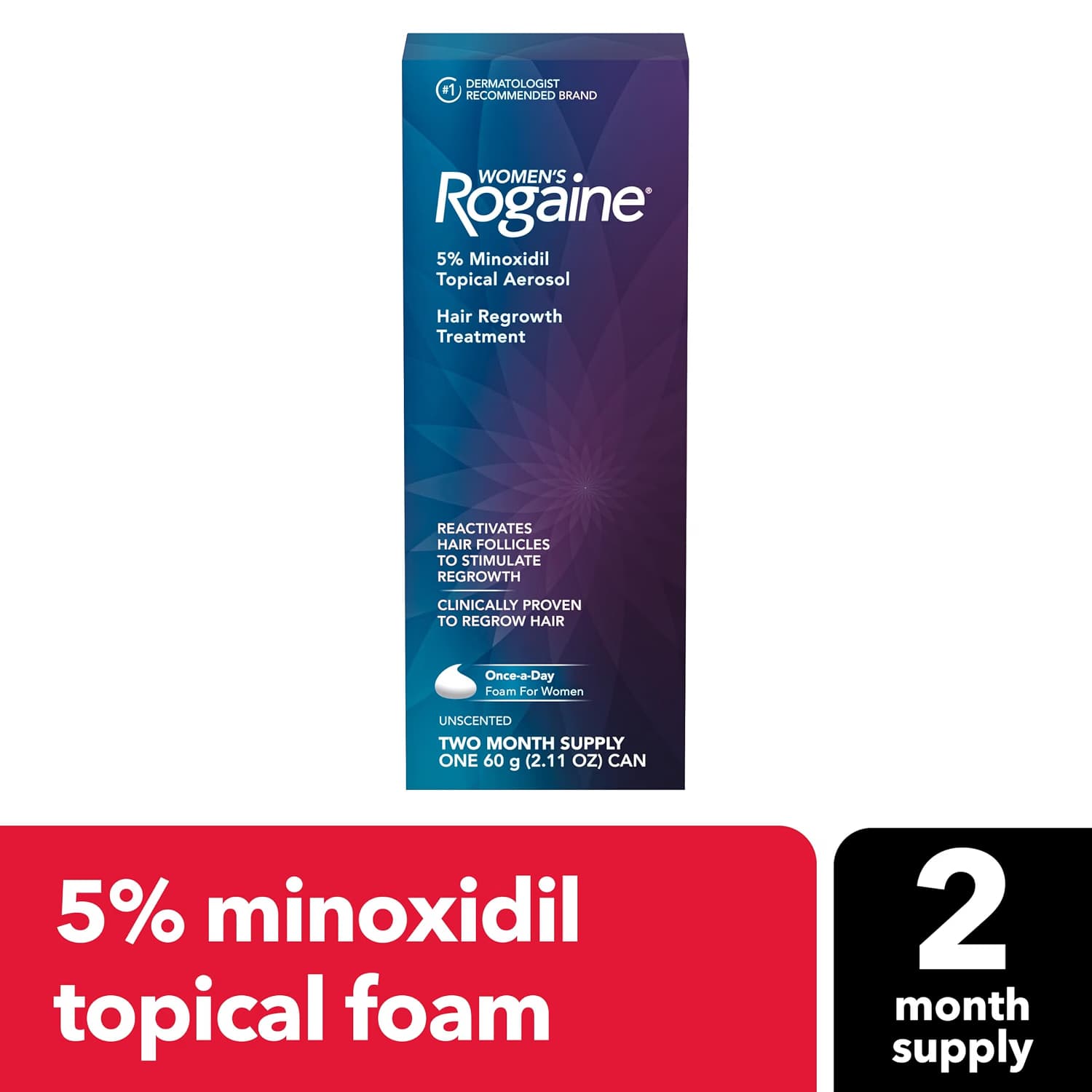
- Women's Rogaine 5% Minoxidil Foam is applied once a day. Its label says results may show at about 3 months, and some women need at least 6.
Rogaine
Women's Rogaine 5% Minoxidil Foam for Hair Thinning and Loss, Topical TreatmentEvidence: Strong.
- Men's Rogaine 5% Minoxidil Foam is applied twice a day to the top of the scalp, and its label says it isn't meant for a receding hairline. Results may show at about 2 months; some men need at least 4.
- Give it time: The AAD suggests 6 to 12 months of steady use before judging it, and says some women notice a temporary increase in shedding in the first 2 to 8 weeks. Results last only as long as you keep using it.
- Read the warnings: The labels say not to use it if you're under 18, have no family history of hair loss, or have a red, irritated or painful scalp, and to ask a doctor first if you have heart disease. The women's label adds hair loss related to childbirth. Both say it may be harmful if used while pregnant or breastfeeding. The foam is extremely flammable, and the AAD warns that minoxidil can be toxic to cats and dogs.
If you want to try rosemary anyway
Trying rosemary oil is a reasonable experiment if your thinning is gradual and your expectations are modest. Some ground rules:
- Rule out other causes first. Sudden, patchy or fast hair loss needs a dermatologist, not an oil.
- Never apply it undiluted. Mix a few drops into a carrier oil such as jojoba or coconut. Poison control specialists advise against undiluted essential oils on skin, and against using them on damaged skin at all. We couldn't find a tested dilution to recommend, because the 2015 trial's summary doesn't give one.
- Patch-test first. Rosemary can cause allergic contact dermatitis. A 2014 review of case reports calls it uncommon but possibly underdiagnosed, and reactions have crossed over to thyme. If your scalp itches, burns or turns red, stop and see a dermatologist.
- Keep it away from your eyes and from children. Poison centers list eye irritation and pain among the effects of essential oils, note that the bottles often lack child-resistant caps, and say children under 6 are most at risk. Never swallow it. If someone swallows essential oil or you're worried about an exposure, call Poison Control at 1-800-222-1222.
- Skip it if you're pregnant or breastfeeding unless your doctor agrees. Cleveland Clinic advises against it.
- Give it six months. In the trial, nothing measurable happened by three months. Photograph your part or crown in the same light before you start, so you have an honest comparison later.
- Ask before combining it with minoxidil. The Rogaine labels say not to use it with other medicines on the scalp, so check with a pharmacist or doctor before adding an oil.
Where we land
Rosemary oil has one small, encouraging trial, some interesting lab work and a great deal of enthusiasm online. That's enough to call it worth studying, not enough to call it a proven treatment. For hereditary thinning, the option with far more evidence is minoxidil, used as the label directs. If you'd still rather try rosemary, dilute it, patch-test it and give it six months. And if your hair is falling out in a way that feels sudden or strange, let a dermatologist take a look first.
This is general information to help you choose products, not medical advice. Skin responds differently from person to person. Patch-test new products, follow label directions, and talk to a dermatologist or doctor about skin conditions, prescription treatments, pregnancy or breastfeeding.
Products in this article
Paid links. As an Amazon Associate I earn from qualifying purchases.
Rogaine
Women's Rogaine 5% Minoxidil Foam for Hair Thinning and Loss, Topical Treatment
A 5% minoxidil foam, an FDA-approved OTC drug, that Rogaine labels for women to regrow hair on the top of the scalp, used once a day.