Buying guide · Hair
How to Choose a Dandruff Shampoo by Active Ingredient
A plain guide to the over-the-counter dandruff actives: what each one does, the strengths the FDA allows, who each suits, how to use it, and when to see a dermatologist.
11 min read1 pickHow we research
In this guide
Who this is for
This guide is for anyone with flakes or an itchy scalp who is standing in front of a shelf of medicated shampoos and not sure which one to pick. It sorts them by active ingredient, the part of the label that matters most, and it is fine to finish it and decide your regular shampoo is enough: the American Academy of Dermatology (AAD) says that for most people, dandruff does not need medical attention.
What to look for
- The active ingredient, not the brand name. Over-the-counter dandruff shampoos carry a Drug Facts box with the active ingredient and its strength. One brand can sell several actives under the same name, so read the box.
- What the label covers. Some labels list dandruff only; others also list seborrheic dermatitis (a related condition) or psoriasis. Pick one whose label matches what you have.
- The strength. The FDA's dandruff monograph, the rule that sets which ingredients and strengths over-the-counter dandruff products may use, gives a range for each active. The three monograph picks here sit at the top of their range or at the single allowed strength; the fourth, ketoconazole, is covered separately below.
- Fragrance, dyes and cleansers, if your scalp reacts. Two picks have no fragrance in their ingredient lists; two contain fragrance and dyes.
The dandruff actives, one by one
Researchers link dandruff and seborrheic dermatitis to Malassezia, a yeast that lives on the scalp, according to a 2015 review. Most actives either act against that yeast or help loosen and shed scale. The AAD lists all of the following as ingredients to look for.
Pyrithione zinc
What it does: The 2015 review groups pyrithione zinc with the antifungal treatments for dandruff and seborrheic dermatitis.
Strengths allowed: 0.3% to 2% in rinse-off products for dandruff, and 0.95% to 2% for seborrheic dermatitis. Leave-on products use much less (0.1% to 0.25%).
Who it may suit: People with flaking and itch from dandruff, including those with sensitive scalps, since fragrance-free versions exist. From 0.95% up, the monograph also allows it to be labeled for seborrheic dermatitis.
Selenium sulfide
What it does: NIH MedlinePlus calls selenium sulfide an anti-infective agent that relieves itching and flaking. The 2015 review describes it as slowing skin-cell turnover and loosening scale.
Strengths allowed: 1% for dandruff and seborrheic dermatitis (or 0.6% in a micronized form for dandruff).
Who it may suit: People whose flakes haven't settled with another active. It needs care on light, bleached, tinted, gray or permed hair: the review notes possible orange-brown scalp discoloration, and MedlinePlus advises rinsing with cool water for at least 5 minutes if you use it before or after bleaching, tinting or perming. MedlinePlus also says to remove jewelry first, because selenium sulfide may damage it.
Ketoconazole
What it does: Ketoconazole is an antifungal. The AAD notes dermatologists often prescribe it for seborrheic dermatitis.
Strengths: Ketoconazole is not part of the FDA's dandruff monograph. The 1% shampoo is sold without a prescription under its own new drug application, which the FDA approved in 1997 for Nizoral Anti-Dandruff. Its label covers dandruff only.
How strong the evidence is: A 2015 Cochrane review found ketoconazole worked better than a placebo for seborrheic dermatitis, but those trials mostly used 2% products and ran four or five weeks, and the evidence was rated low quality.
Who it may suit: People with dandruff who want an antifungal on a less frequent schedule: its label says every three to four days.
Salicylic acid
What it does: Salicylic acid helps soften and reduce scale. In its scalp psoriasis advice, the AAD says a product with salicylic acid can soften thick, stubborn patches.
Strengths allowed: 1.8% to 3% for dandruff, seborrheic dermatitis and psoriasis. It is one of only two monograph actives allowed for psoriasis.
Who it may suit: People with thick flakes, scale or build-up.
Coal tar
What it does: The 2015 review describes coal tar as antifungal, anti-inflammatory and scale-loosening, and says it reduces oil. The AAD says it is used less often today but may be recommended if your scalp itches.
Strengths allowed: 0.5% to 5% for dandruff, seborrheic dermatitis and psoriasis, and the label must state the coal tar source and final strength.
What to know first: Coal tar labels must warn that it can increase your tendency to sunburn for up to 24 hours, and the AAD adds that a sunburned scalp can flake more. Labels also say not to use it for long periods without asking a doctor, and not to combine it with other psoriasis treatments, such as light therapy or prescription drugs, unless your doctor tells you to. The coal tar labels we read carry a California Proposition 65 cancer warning, and the 2015 review lists skin irritation, folliculitis and, with prolonged use, a skin cancer risk among its possible effects. We don't feature a coal tar shampoo in this guide. If a dermatologist suggests one, follow its label closely.
Also on the list: Sulfur (2% to 5%) is a monograph dandruff active too, and the AAD includes it among ingredients to look for.
Which active fits your scalp
- Fine, straight or oily hair: Any active can work. The AAD says you can wash often and use a dandruff shampoo about twice a week.
- Coarse, curly or coily hair, or a dry scalp: The AAD suggests a dandruff shampoo about once a week, if tolerated, on the scalp only, because these ingredients can dry the hair, followed by your usual conditioner.
- Color-treated, bleached or light hair: Be cautious with selenium sulfide (see above). Dermatologists quoted by NBC Select suggest choosing a color-safe option, and the AAD's scalp-only advice helps keep medicated lather off your lengths.
- Sensitive or reactive scalp: Look for a shampoo with no fragrance or dyes in the ingredient list, and patch-test first.
- Thick scale or build-up: Salicylic acid is the active designed to soften it.
- Psoriasis: Only salicylic acid and coal tar are monograph actives for psoriasis. Scalp psoriasis is worth a dermatologist visit (see below).
The picks
Best for an antifungal option on a less frequent schedule: Nizoral Anti-Dandruff Shampoo (ketoconazole 1%)
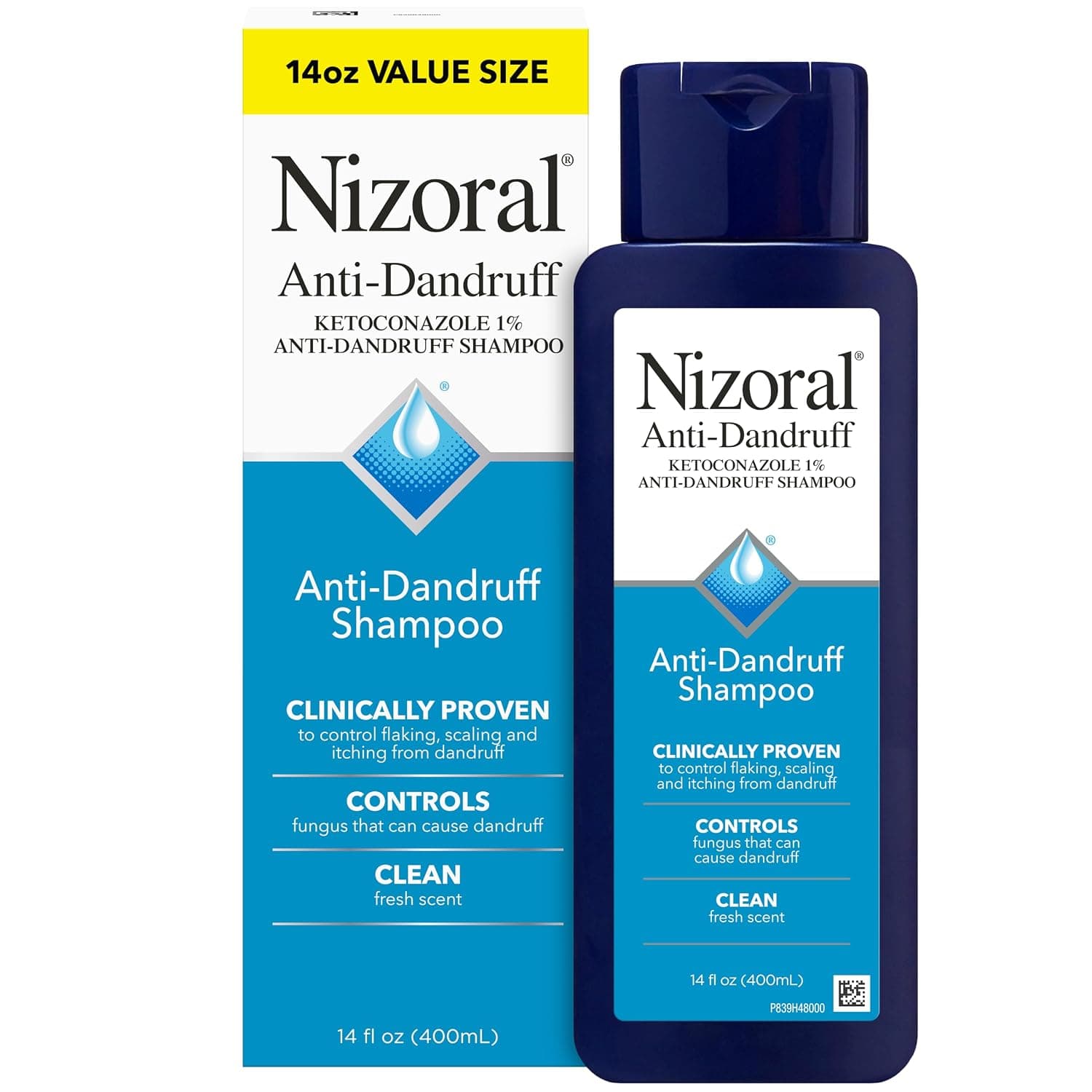
Its label says it controls flaking, scaling and itching associated with dandruff. NBC Select named it its best dandruff shampoo overall in 2026.
- Choose it if: you have dandruff and want to try ketoconazole; you'd like a shampoo the label tells you to use every three to four days for up to eight weeks, then only as needed; or pyrithione zinc or selenium sulfide hasn't helped, since the AAD suggests trying a different active.
- Skip it if: your scalp is broken or inflamed, or you're allergic to any of its ingredients (the label says not to use it); you mainly have seborrheic dermatitis or psoriasis, because its label lists dandruff only; you react to fragrance or dyes; or you're shopping for a child under 12 (the label says to ask a doctor). If you're pregnant or breastfeeding, the label says to ask a doctor first. Nizoral comes in several 1% versions, including scented and 2-in-1 bottles, so check which one you buy.
Best for sensitive scalps: Vanicream Dandruff Shampoo (pyrithione zinc 2%)
Labeled for dandruff and seborrheic dermatitis, and free of fragrance, dyes, parabens and sulfates, according to the bottle. NBC Select named it its best dandruff shampoo for sensitive scalps in 2026. It was previously sold as Vanicream Free & Clear.
- Choose it if: your scalp reacts to fragrance, dyes or strong cleansers; or you want a medicated shampoo with a short, plain ingredient list.
- Skip it if: you've used pyrithione zinc regularly without improvement (switch actives instead); you want a rich lather or a scent, since NBC Select notes it can be drying; or your condition covers a large area of your body, in which case the label says to ask a doctor first.
Best for a cooling feel: Selsun Blue Medicated Anti-Dandruff Shampoo (selenium sulfide 1%)
A maximum-strength selenium sulfide shampoo with menthol, which dermatologist Dr. Isabela Jones told NBC Select helps relieve mild itching. NBC Select named it its best dandruff shampoo for cooling in 2026.
- Choose it if: you have flaking and itching from dandruff and like a cooling feel; or another active hasn't helped and you want to try selenium sulfide.
- Skip it if: you react to fragrance, dyes or sulfate cleansers (it contains all three); you have bleached, tinted, permed or light hair and don't want to risk discoloration; or you mainly have seborrheic dermatitis, since this label lists dandruff only. Selsun Blue sells other shampoos with pyrithione zinc or salicylic acid under the same name, so make sure the label says selenium sulfide 1% and Medicated.
Best for thick scale and build-up: Neutrogena T/Sal Therapeutic Shampoo (salicylic acid 3%)
Its Drug Facts list dandruff, seborrheic dermatitis and psoriasis as purposes, and Neutrogena aims it at scalp build-up. It has no fragrance in its ingredient list, and the National Psoriasis Foundation includes it in its Seal of Recognition program. NBC Select named it its best dandruff shampoo for build-up in 2026.
- Choose it if: you have thick flakes, scale or build-up; or you'd like a medicated shampoo without fragrance in the ingredient list.
- Skip it if: your condition covers a large area of your body (the label says to ask a doctor first); you think you have scalp psoriasis but haven't seen a doctor yet; or you want a large bottle, since the original is 4.5 fl oz (two newer 8 fl oz versions also exist). If you're pregnant or breastfeeding, ask your doctor or pharmacist before using a 3% salicylic acid product.
How to use a dandruff shampoo
- Start with one active and follow the label. The shampoo labels here say to use them at least twice a week, except Nizoral, which says every three to four days for up to eight weeks.
- Lather it onto the scalp, not the lengths. The AAD says to apply it to the scalp, especially if your hair is coarse, curly or coily, because these ingredients can dry the hair.
- Give it contact time. Vanicream and T/Sal say to leave the lather on for several minutes. The AAD says some dandruff shampoos need up to 5 to 10 minutes and to follow the bottle; dermatologist Dr. Isabela Jones told NBC Select two to five minutes. The Selsun Blue and Nizoral labels give no leave-on time.
- Condition the lengths. Dr. Jones suggests keeping conditioner off the scalp and on the lengths of your hair.
- Rotate if it stops working. The AAD suggests alternating between shampoos with different actives if one doesn't help or stops working as well.
- Keep a maintenance wash. Dandruff and seborrheic dermatitis tend to come back. The AAD says many people keep using a dandruff shampoo about once a week to prevent flare-ups.
- Ask before combining scalp medicines. If you use minoxidil (for example Women's or Men's Rogaine), ask a doctor or pharmacist first: the Rogaine labels say not to use it with other scalp medicines.
Common mistakes
- Shopping by brand name. Selsun Blue, Nizoral and T/Sal each come in more than one version. Check the active and the version on the label.
- Rinsing straight away. Labels that say to leave the lather on for several minutes mean it.
- Scrubbing hard. The AAD says rubbing, scrubbing and scratching can worsen scalp psoriasis. Massage gently.
- Skipping sun protection with coal tar. Coal tar can make your scalp more prone to sunburn for up to 24 hours.
- Pushing on when it isn't working. Every label here says to stop and ask a doctor if your scalp gets worse or doesn't improve with regular use; Nizoral's says to do so after two to four weeks, or if a rash appears.
When to see a dermatologist
- Your dandruff doesn't go away with an over-the-counter shampoo, or it becomes severe. The AAD says a board-certified dermatologist can check whether something else, such as seborrheic dermatitis, psoriasis, a scalp fungal infection or eczema, is the cause, and can prescribe stronger treatment.
- Your scalp gets worse, a rash appears, or it doesn't improve after regular use as directed.
- The condition covers a large area of your body, or your scalp is broken or inflamed.
- You think you have scalp psoriasis.
- The flakes are on a baby's scalp. The AAD says dandruff shampoo isn't recommended for babies with cradle cap; ask your pediatrician.
FAQ
Is dandruff the same as seborrheic dermatitis?
They're closely related, and a 2015 review links both to Malassezia yeast. Many labels list both conditions, but some, such as Selsun Blue Medicated and Nizoral, list dandruff only. A dermatologist can tell you which you have.
Which active is the strongest?
We don't rank them. A 2015 Cochrane review found ketoconazole and ciclopirox performed similarly, with too few studies to show that one antifungal beats another, and most trials lasted about a month. Even a shampoo maker's own review promoting selenium sulfide acknowledges there is no published head-to-head trial of 1% selenium sulfide against 1% ketoconazole. The best active is the one that works for your scalp, which is why the AAD suggests rotating.
How long until I see a difference?
The labels don't promise a timeline. Nizoral's says to ask a doctor if there's no improvement in two to four weeks, and the others say to ask a doctor if your scalp doesn't improve after regular use as directed.
Can I use a dandruff shampoo on color-treated hair?
Usually, with care. Apply it to the scalp only, as the AAD suggests. With selenium sulfide, MedlinePlus advises a long cool-water rinse around bleaching, tinting or perming.
Do I need it every time I wash?
No. Most labels say at least twice a week, and the AAD suggests about twice a week for fine or oily hair and about once a week for coarse, curly or coily hair. Use your regular shampoo on other days.
This is general information to help you choose products, not medical advice. Skin responds differently from person to person. Patch-test new products, follow label directions, and talk to a dermatologist or doctor about skin conditions, prescription treatments, pregnancy or breastfeeding.
Products in this guide
Paid links. As an Amazon Associate I earn from qualifying purchases.
Nizoral
Nizoral Anti-Dandruff Shampoo with 1% Ketoconazole (14 fl oz)
An over-the-counter dandruff shampoo with 1% ketoconazole, an antifungal. The label says to use it every three to four days for up to eight weeks.